India’s Ruthless 7-Wicket Win Over South Africa
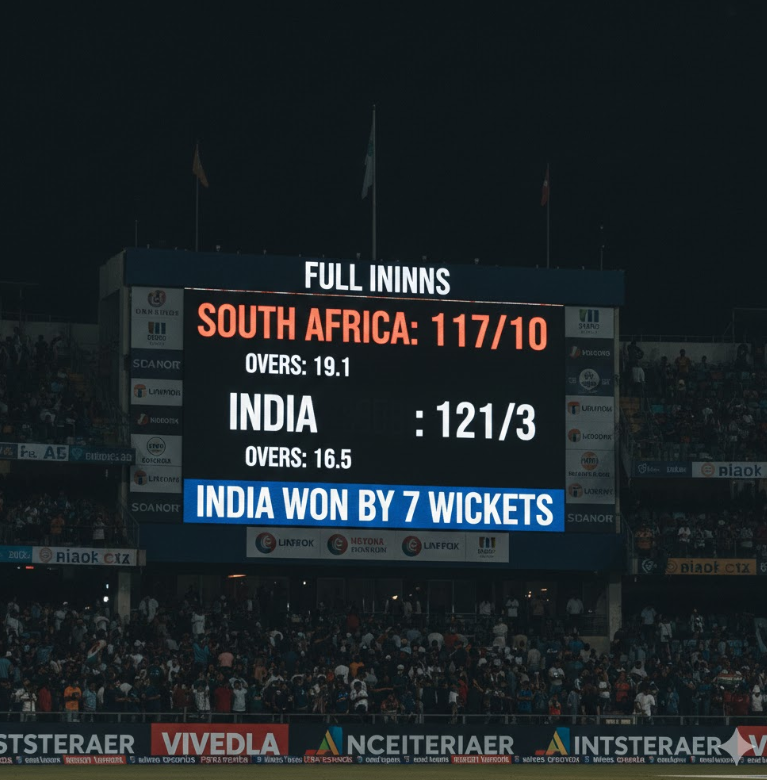
India didn’t just beat South Africa in the third T20I — they dismantled them. The scoreboard may show a seven-wicket win, but the real story is how completely India’s pace attack choked South Africa’s lineup. This wasn’t luck, momentum, or “just another match.” It was a blunt reminder that when India’s bowlers actually execute with discipline instead of showmanship, the opposition collapses.
Let’s break the match down without the useless celebrations and pointless hype.
South Africa were restricted to 117, a total that isn’t even competitive in modern T20 cricket. Their collapse wasn’t accidental. It happened because India’s pacers didn’t waste deliveries, didn’t bowl freebies, and didn’t chase glory balls. Arshdeep Singh, Harshit Rana, Hardik Pandya, and Shivam Dube delivered a rare combination of accuracy and aggression — something India usually forgets when pressure builds.
Arshdeep started the destruction immediately. His swing, combined with consistency for once, sent Reeza Hendricks back for a duck. That early punch broke South Africa’s rhythm before they could even settle. Harshit Rana followed with a crucial spell, removing key batters and forcing South Africa into survival mode instead of scoring mode. When your opener and middle-order crumble before the powerplay even ends, you don’t recover.
Hardik Pandya, who’s been questioned endlessly about his fitness and form, finally delivered something substantial. Completing 100 T20I wickets isn’t a minor achievement; it’s a sign that when he stops overcomplicating his bowling, he becomes effective. Shivam Dube backed the group by shutting down the run flow and dismantling the lower middle order.
South Africa’s performance was a disaster, but India didn’t let them breathe. That’s the difference. Quinton de Kock, the only batter capable of anchoring the innings, was removed before he could create any momentum. Dewald Brevis — hyped as the next-gen power hitter — was shut down instantly. With the top order gone, South Africa played scared cricket. That’s why they crawled to a pathetic total. India didn’t need magic; South Africa handed them a weak target.
Chasing 117 should never be complicated for a team with India’s depth, but India has a habit of making simple tasks messy. This time, they didn’t. Abhishek Sharma and Shubman Gill played with clarity instead of their usual overconfident laziness. Both delivered a stable platform and prevented unnecessary collapses.
Tilak Varma remained unbeaten, showing that at least one young Indian batter understands the meaning of composure. India finished the job in the most basic way possible — no drama, no stupidity, no throwing away wickets.
This win gives India a 2–1 lead in the five-match series. But don’t confuse this with dominance. India won because the bowlers executed and the target was embarrassingly low. If India wants to close the series, the batting lineup must show the same discipline even when the target isn’t a walk-in. And the bowlers must repeat this performance — not collapse back into inconsistency.
South Africa’s defeat was deserved. Their shot selection was pathetic, their intent was missing, and their ability to handle pressure was nonexistent. India took advantage, and for once, didn’t let go of the momentum.
The real takeaway from this match is simple:
When India stops playing emotional cricket and starts playing calculated cricket, they look unbeatable.
But when they get arrogant or sloppy, they fall apart instantly.
This match showed the version of India that wins matches ruthlessly. The question is whether they will maintain this level or fall back into their usual unpredictability. The rest of the series will answer that.